Polar Bear Habitats
Major Habitat Type
Arctic sea ice
Biogeographic realm
Nearctic and Palearctic
Range States
Canada (Manitoba; Newfoundland; Northwest Territories; Nunavut; Ontario; Quebec; Yukon), Greenland, Norway (Svalbard), Russian Federation (Krasnoyarsk; Magadan; North European Russia; West Siberia; Yakutiya), United States (Alaska)
Geographical Location
Arctic
Ecological Region
Alaskan North Slope Coastal Tundra, Canadian Low Arctic Tundra, Taimyr and Siberian Coastal Tundra, Chukote Coastal Tundra, Bering-Beaufort-Chukchi Seas, Barents - Kara Seas, Grand Banks, Canada

Sea Ice Habitat
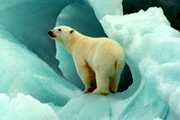
Polar bears are found throughout the circumpolar Arctic on pack ice, along or near coasts, and on islands.
They share this habitat with indigenous peoples, and animals such as ringed seals, arctic foxes, narwhal, beluga whales, and millions of migratory birds.
The polar bear needs sea ice to survive ...
Polar bears live on the annual arctic sea ice that provides a platform from which they can hunt, live, breed, and in some cases create maternal dens.
Sea ice is more than a simple platform: it is an entire ecosystem inhabited by plankton and micro-organisms, which support a rich food chain that nourishes seals that in turn become prey for polar bears.
It is the very foundation and defining characteristic of the arctic marine ecosystem.
... but as the Arctic warms, the sea ice declines
When the edge of the ice retreats to the north during summer, and it is retreating further and further each year, bears must follow the ice floes north to stay close to seals and other prey.
Otherwise, they become stranded and must spend their summers on land until the sea ice forms again in the fall, living off body fat stored from hunting in the spring and winter.
The greater extent of melting sea ice during the arctic summer is becoming an increasing problem for bears seeking places to hunt, breed and sometimes den.
Polar bears are left with less time to hunt for food. As their ice habitat shrinks bears in the southern limits of the Arctic - especially around Hudson Bay, Canada - face a grave threat to their survival.
At the current rate of climate warming, experts predict that there will be no ice in Hudson Bay by 2080.